
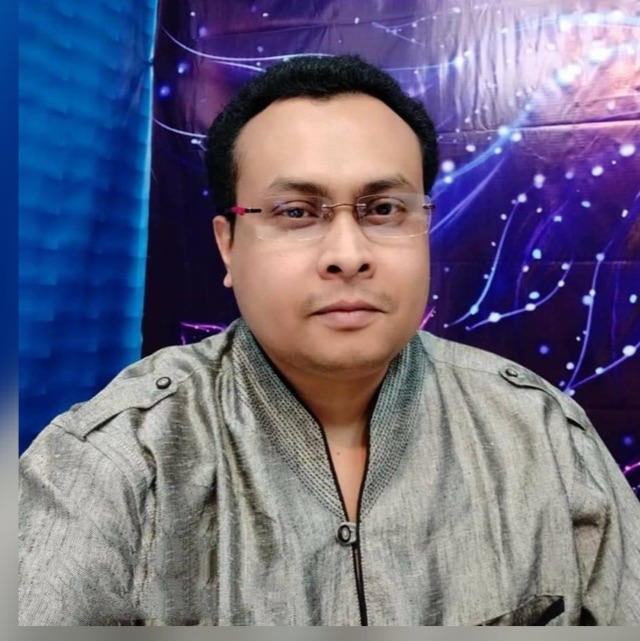
Shri Abhijit Mukherjee (Known as Prof. Abhijit Krishnan by his Pen Name) took birth in the year of 1982 in a Bengali family at Kolkata; he has completed C.S (Int.) from Delhi ICSI as his regular education and did job for just 2 years, due his passion and love for Jyotish. From his childhood he used to take interest in various spiritual subjects along with jyotish but obviously through logical manner. At the age of just 13, he started his journey in Jyotish Shastra through his mathematics teacher late Shri Tarun Upadhay Mahashaya (Banaras / Calcutta), after that he was pursuing his astro-journey through various field of astrology along with his regular education. He has visited numerous places in India and gathered immense knowledge in Indian Astrology.
His special subject of interest & expertise is Nadi Jyotish, which he got mainly from Tamil Nadu, Delhi, Punjab & Banaras. In his Nadi Astro journey he got immense help from many people as his gurus & mentors among them late Mr. T. Chandrasekhar (Thanjavur, Tamil Nadu), late Mr. S. Ramaprasada (Bangalore), Mr. AV Sundaram (Secunderabad), Mr. Umang Taneja (Punjab / Delhi) were the main.
"WHAT IS NADI JYOTISH"
The word NADI means Root, which needs to do ‘In search of’ i.e., to search for the root of anything is called Nadi. When this word connects with Ayurveda it indicates the Pulse i.e., the unique vibrating point which is indicating the channelized life force in human body, on the other hand when it is used in case of Jyotisha then it becomes the search for subtlest Arc of a rashi in the entire zodiac. Jyotish means The light of Divinity (Jyoti + Ish) or the Light of Nakshatra in other sense. Jyotish is the ultimate divine tool to get insights in different context of life, because it tries to study the Time. When Nadi uses as prefix before Jyotish is called NadiJyotish.
The same subject is known as Samhita in North India (which are slightly variant version of Nadis) & as Nadi Jyothidam in South India.
We can compare nadis’ works with a big Banyan Tree. Many branches from the top reach the ground to take the root. As per our historical data, this subject was invented & revealed by Lord Shiva to Mata Parvati as Agama Vidya, spreaded by Sage Bhrugu & Agathiyer in North & South India respectively.
After them step by step all these processes have been passed out time to time from one sage to another sage through their disciples. These Precious Paramparas are the main contains of my research.
The classical work on Nadi have compiled by 7 sages (Atri, Agastya, Vasistha, Narad, Songinar, Vishwamitra & Jayamuni), broadly known as Saptarushi Nadi. Apart from them, 18 Sidhars (Siddha Purushsa) of Tamil Nadu has also proceeded their excellency followed by Saptarushi & others. Name of their Nadis are:
Types of Nadi in Old Tamil (Vatthhezzetthu) by 18 sidhars;-
1. Agathiyar Nadi
2. Bogar Nadi
3. Therayar Nadi
4. Nandhidevar Nadi
5. Thriumoolar Nadi
6. Konganar Nadi
7. Machamuni Nadi
8. Korakkar Nadi
9. Sattaimuni Nadi
10. Sundaranar Naadi
11. Ramadevar Nadi
12. Kudambai Nadi
13. Karuvoorar nadi
14. Edaikadar Nadi
15. Azhuganni Naadi
16. Agapai Nadi
17. Kagapujendra Nadi
18. Pambatti Nadi
Nowadays in India the three main Method are going on, in the name of predictive astrology these are Nadi, Parashari & Jaimini system, Parashari is of course the most widely used system, while Jaimini is practiced by a few selected adepts. But the Nadi system is a class by itself, due to its’ unavailability & proper interpretations it is not so much popular till date, but Nadi is the most adorable & precious system due to its’ stunning accuracy and practicality.
The two most important intention of Jyotish shastra are, 1). Predict Events along with correct time frame for the betterment of human being, and 2). Suggest proper Remedy (Parihara) for the protection of evil deeds and sins of Past Life Karma and This Life Karma. Mainly Jyotish is the puzzle of Time & Space. 2 luminaries, called Sun and Moon signifies Time & Space respectively. Sun governs 12 Rashis whereas Moon governs 16 Tithis,their relative distance all together called SPACE – TIME.
On the Earth, HUMAN TIME govern by ghatis or ahoratra in past era, there were 60 Ghatis mentioned as Ahoratra. In modern day which is addressing as 24 hrs. or One Day. Ahoratra based on the daily motion of t h e Earth. In Nadis, mainly 2 mother types of Amsha of Kaal (Time) are existing, named as, Suryakala or Unequal bifurcation of Rasi and Horakala or Equal bifurcation of Tithi based upon Human Time. Tithis are related with Moon’s motion along with human time, naturally it should also be treated as Chandrakala, though it is Equal. In Nadis, Day time govern by Sun & Night time govern by Moon, 12hrs (6A.M. to 6P.M.) + 12hrs (6P.M. to 6A.M.), respectively. Which are collectively called as Ahoratra.
In case of Movable rashi, the rotational sequel of nadiamsha follows 1 to 150. In case of Fixed rashi, the rotational sequel of nadiamsha follows 150 to 1 & in case of Dual rashi, the sequel starts from 76 to 150 & 1 to 75 respectively. The sequel built upon to followed the movement of human life, like
“Start-Middle-End” or“Movable-Dual-Fixed”.
Nadis mainly divided in two parts, 1) Jeeva Nadi and 2) Ajeeva Nadi.
Jeeva Nadis are known as the speaking Nadis which are mainly use in Nadi readings, by various Nadars (who reads nadi called nadar) this is also called “Siddhya Jeeva Nadi” because this process is absolutely Siddhi based (either of God or Spirit) technique.
Ajeeva Nadi having Two segments Jyotisham & Abhayasa (i.e., practical practice) Kandams. Jyotisham are having 2 more sub parts called Vakkyam & Suthram, both parts are having 3 segments they are Kaala Jathagam, Prashna Jathagam & Nadu Jothidam. On the other hand, Abhayasa Kandam is having 3 sub parts called Tantra Kandam, Mantra Kandam & Aushaadhi Kandam.
In case of some pre – written nadis (claimed as written by various sages) which are also to be treated under Vakkyam section work, narrated in details regarding native’s life. For this section the Thumb impression is required (Right for Male & Left for Female) to identify the specific Olai & to read the
matter regarding natives’ entire life which is already narrated by various Sages, written & collected by their disciples and kept through Olai Chauvadi (Palm Leaf Manuscript). Though everyone’s horoscope is not available in this section.
Apart from Palm Leaf theory, under Suthram section, Data of Birth is required for the prediction regarding native’s life. Sometimes through Prashna the prediction can be done too. It is built on some composed formulas, sensibly given by our ancient sages; you need to learn it properly from your Guru/Mentor.
It is said that, 72 types of Nadis were existing, among them 36 (18 Vakkyam & 18 Sutram) are Jyotishamand rest 36 (12 Mantra + 12 Tantra + 12 Aushadhi) are Abhayasa. Nadis were mainly written either in Antadi Meter or in Asiriyappa Meter or in Anustupa Meter. Uses of Katapayadi Vargas (ancient tricks of reverse writing) are also use to found in various nadis. Mainly Nadis were written in old Tamil (that language is called Vatthezetthu). Nadi manuscripts are composed in the form of Tamil classical poetry called Venpa & Virutham. Mainly Pambu Panchangam with Samvatsara Kaala was adopted to cast any native’s horoscope. Nowadays Pambu Panchang is popularly known as Vakkya Panchangam (in South India only) which is nothing but a zonal version of Sri Surya Siddhanta method.
Nowadays in Vaitheswaran Koil Temple (Thanjavur), Adyar Library (Chennai), Government Oriental Manuscript Library (Chennai), Swaraswati Mahal Library (Thanjavur), Mysore University Library (Mysore) Etc. are the main places where the nadis are kept under surveillance by authorities. Apart from that,some old families are living in South India, Punjab, Banaras, Gujarat & Nepal, who’s also having some typical manuscript-based methods for practice, as they are clamming themselves as the descendant of various Sages. Ajeeva Nadis are having 16 divisions in total including predictions and remedies, from 1st house to 12th house chapter’s results along with Diksha, Aushadhi, Pariharam & Dasa. In Tamil language Chapter is called Kandam. 16 Kandams are present in case of any Nadi whether it’s Vakkyam or Suthram.
I am lucky enough to get the system from my various Gurus and Mentors, among them late Acharya Tarun Upadhay ji (Banaras / Calcutta), late Mr. T. Chandrasekhar ji (Thanjavur, Tamil Nadu), late Mr. S. Ramaprasada ji (Bangalore), Mr. AV Sundaram ji (Secunderabad), Mr. Umang Taneja ji (Punjab/Delhi) are the main. Without their help and guidance, it could be impossible for me to be in this field and it could have been absolutely impossible to decode the truth behind this very ancient method. I would like to bow my head on their louts’ feet.
Nowadays lots of fake things have taken place in the name of various nadis. It is absolutely impossible to say that, which manuscript or document is real one, as it is oldest tradition in the field of jyotish and our country faced various interventions by out siders so it is very difficult to say, “this particular system is belonging from this particular sage”. But by the grace of almighty and my Gurus I have earned such precious Pearls from Guru-Shishya Parampara which are true knowledge by various ancient siddhars and sages.